UPDATE: Because of a wintry forecast, St. Peter’s has rescheduled this event to Friday, Feb. 28, 2025, from 7 pm to 10 pm.
From St. Peter’s Episcopal Church in Morristown:
Get Ready to Swing the Night Away at our Sweet Swing Soiree
Join us for a lively and unforgettable evening at our first Sweet Swing Soiree on Saturday, Feb. 15, 2025, from 7pm to 10 pm at St. Peter’s Episcopal Church in Morristown.
Step back in time and enjoy the timeless sounds of the swing era, brought to life by the incredible 18-piece Bottle Hill Big Band. Set in the charming, historic St. Peter’s Parish Hall in Morristown, this promises to be a night of music, dancing, and pure joy.
Treat yourself to delicious drinks and tempting desserts, free dance lessons at 7 pm and the band kicking off at 7:30 pm!
This event is open to all, so bring your friends and family for a swinging night to remember! Tickets are $35
Technology giant Microsoft is buying nearly 400 MW of power from three new utility-scale solar projects in Illinois and Texas. EDP Renewables North America (EDPR NA) on Feb. 10 said the installations have come online with long-term virtual power purchase agreements (PPAs), through which Microsoft will take 389 MW of electricity and renewable energy credits.
The companies on Monday said they now have collaborated on five renewable energy projects in the U.S.
EDPR NA commissioned the 140-MW Wolf Run Solar Project near Jacksonville, Illinois, along with the 100-MW Hickory Solar Project in Jerseyville, Illinois, on the east side of the Mississippi River just north of St. Louis, Missouri. The company also is now operating the 150-MW Cattlemen II Solar Project about 70 miles northeast of Austin, Texas.
“The importance of ensuring benefits flowing from renewable energy development directly into communities has never been more important,” said Sandhya Ganapathy, CEO, EDP Renewables North America. “Through these three additional projects, we’re keeping our promise—and indeed the industry’s promise—to contribute to the nation’s growing energy demand and in that process invest in long-lasting economic growth of our communities.”
The Hickory project uses an Environmental Justice PPA (EJ PPA) developed by Microsoft and Volt Energy Utility, a minority-owned renewable energy developer focused on clean energy investments in rural and urban communities that have been impacted by pollution, and are considered more vulnerable to the impacts of climate change. Hickory as part of the EJ PPA will contribute funding to enable Sharing the Power Foundation to offer financial assistance to organizations and causes that ensure equal access to clean air, water, and renewable energy, as well as offer availability to energy assistance programs. It also will offer opportunities to pursue workforce training in clean energy careers.
Wolf Run and Hickory have contributed $4.8 million to landowners, who lease a portion of their land to the projects, and millions of dollars to local governments through tax payments. The two Illinois projects created 500 construction jobs and five permanent jobs.
Cattlemen II in Texas will also contribute millions in taxes, benefiting the local school district and local government. The project created about 300 construction jobs and will support several permanent jobs in the area.
“It’s exciting when projects achieve commercial operations and begin generating clean energy in support of grid decarbonization,” said Kourtney Nelson, senior director of Renewable Energy Procurement, Microsoft. “We’re pleased with EDPR NA and Volt Energy Utility’s collaboration on Hickory and the positive impact the project will have with community grants and investing in future renewable energy leaders.”
After scrapping the 10-minute food delivery service in 2023, Zomato has re-entered the instant food delivery market in 2025. The homegrown food-tech giant has reportedly launched a 15-minute food delivery service in select cities. This comes as its biggest rival in the country, Swiggy, launched its quick food delivery service – ‘Bolt’ – in October 2024. For now, Zomato’s new quick food delivery service is reportedly live in parts of Delhi-NCR.
The Gurugram-based company is planning to rapidly scale up this new service across the city. However, neither the company nor CEO Deepinder Goyal has confirmed this development yet. Under this new service offering, the Zomato app displays restaurants within a limited radius of 1.5–2 km for orders.
With this fresh development, Zomato may seem to be competing with its own quick commerce arm, Blinkit – which was acquired in 2022. Notably, last month, Blinkit launched a new standalone app – Bistro. This is also a quick commerce food delivery service. Using this app, users can order snacks and beverages and receive delivery in 15 minutes.
In the business sector, quick commerce has emerged as a new hot trend, much like AI in the tech sector. In India, the quick commerce industry is expected to reach $9.95 billion by 2029. It is also estimated to have around 60.6 million users by 2029, a significant increase from approximately 26.2 million in 2024.
Interestingly, in the quick commerce industry, primarily dominated by grocery deliveries, the instant food delivery culture is also rapidly gaining popularity. There are several significant players in this sector in India, including Zomato’s Bistro, Swiggy’s Bolt, Dash (Ola Consumer), and Magicpin’s MagicNOW. Among them, Zepto Cafe is also a prominent player, offering 10-minute food delivery since 2022. Last month, the company’s co-founder Aadit Palicha claimed that Zepto Cafe is adding 100 cafes a month and is currently clocking 30,000 orders a day.
Even though the 10-15 minute food delivery service has also attracted a lot of criticism over food quality and health concerns, it hasn’t stopped big giants from betting on it. According to a JM Financial report, India’s online food delivery market is expected to more than double, reaching $15 billion by March 2029.
In November 2024, Zomato completed its $1 billion Qualified Institutional Placement (QIP) fundraising. The significance of this fund increases further as a major chunk of the proceeds will be deployed to expand Blinkit’s network of dark stores and warehouses. Talking about Zomato’s financials, it recorded a 389% year-on-year surge in net profit for the second quarter of FY25, reaching ₹176 crore. Meanwhile, it also reported a 68% increase in revenue, reaching ₹4,799 crore for the same period. Additionally, the company has $1.3 billion in cash reserves.
Evan Nuzzi credits the Morristown Starbucks for his shot at fame and fortune.
“I ran to the bathroom and sang it into my phone so I wouldn’t forget it,” Nuzzi, 21, said of a song he composed during his shift at the coffee shop.
Come March 4, 2025, Nuzzi will perform his composition at Morristown Onstage. He will join 15 other amateur acts who live, work or study in Greater Morristown competing for cash prizes at the Mayo Performing Arts Center, in the Morris Educational Foundation’s 18th annual fundraiser for the Morris School District.
Titled I Know it’s Wrong, Nuzzi’s song illustrates “the split second that you picture spending the rest of your life with someone,” he said. ”It’s about falling in love.”
Morristown Onstage 2025 finalist Evan Nuzzi enjoys a laugh on Media Day. Photo by David Okada
The same day he wrote I Know it’s Wrong, he came across a Morristown Onstage flier dropped off at Starbucks.
“Something just drew me in,” he said. “First the song came to me and then the pamphlet. That was two things in the same store.”
Starbucks musings aside, Nuzzi has been songwriting for the last six or seven years. He draws his inspiration from the likes of Paul McCartney, Stevie Wonder and Billy Joel. He also has The Beatles on hand for his go-to playlist.
In addition to songwriting, the Somerville resident plays piano and guitar, which he learned from his father. He is teaching himself the drums.
No stranger to audiences, Nuzzi has performed all over New Jersey and — and once in Jamaica.
“I was on vacation and there was a talent show that was being hosted and I ran over, last second, to audition,” he said. “I got in and got to play in front of around 100 people. It was very cool.”
To date, he boasts 45 original songs that focus mostly on love and heartbreak.
He finds a therapeutic value in the process of songwriting. “It’s a way to get my emotions out,” he said. “Writing is always there and something you can come back to.”
When Nussi’s not singing into his phone, he is chilling with friends or slinging cappucinos as store manager at Starbucks.
Should he win the $1,000 top prize, he plans on buying a piano.
“I kind of played it into the ground,” he said of his old one.
Sixteen top amateur acts from Greater Morristown will compete at the Mayo Performing Arts Center on March 4, 2025 for cash prizes at the 18th annual Morristown Onstage. Presented by the Morris Educational Foundation, the show benefits programs in the Morris School District. Tickets are $43-$95, available online or at MPAC, 100 South St., 973-539-8008.
Two Meritus Health team members were among 10 winners in a statewide competition to find innovative ways to make patient care better and more affordable.
Carly Critchfield and Miranda Ramsey each were recognized for ideas chosen in the Health Services Cost Review Commission’s Advancing Innovation in Maryland Contest.
Launched in the fall in partnership with the Maryland Department of Health, the Abell Foundation, and the Horizon Foundation, the contest leverages Maryland’s unique healthcare model, which creates opportunities to invest in preventative care.
There were 40 submissions to the contest spanning the state, and the contest was judged by an independent panel of experts.
Critchfield, supervisor of outpatient practices at Valley Mall, sought to reach isolated patients with a “well wheels” program, which reimagines physician house calls by using mobile healthcare teams across the state.
Ramsey, vice president of physician services, aimed to support patients with diabetes through a “diabetic door dash” program that combines medical care, nutritional support and social services.
“Innovation comes in many forms,” said Meritus President and CEO Maulik Joshi, Dr.P.H. “These ideas are examples of Meritus leaders’ continuous focus on improvement for patients. By addressing critical health challenges with forward-thinking solutions, we are not only enhancing care in our local community but also contributing to broader efforts to improve health outcomes across the state.”
“The AIM contest demonstrates that there is no shortage of great ideas in Maryland health care,” said Jon Kromm, executive director of the HSCRC. “This contest will serve as a spark for the commission and the healthcare sector to pursue innovation in care delivery to support better health at lower cost across the state.”
Giant deep-sea tube worms. When the RV Knorr arrived above Galapagos Rift in 1977, a team of geologists, geochemists, and geophysicist, including Robert Ballard who would go on to locate the wreck of the Titanic among other ocean-shaping discoveries) was prepared to witness something never before seen: a geyser of superheated, chemical rich water erupting from the seafloor at extreme depth and pressure. A deep-sea hydrothermal vent.
They were not prepared to find life, especially life that would fundamentally alter our view of what it means to be a living organism on Earth. When Alvin touched down on the site that would be soon named Garden of Eden, it found an oasis in the deep ocean–an ecosystem built by towering, bright red tube worms, who flower-like plumes wafted through the hydrothermal fluid. The discovery of these incredible ecosystems was so unexpected that Ballard, decades later, would write that those first specimens were preserved in vodka from the scientists’ personal stash.
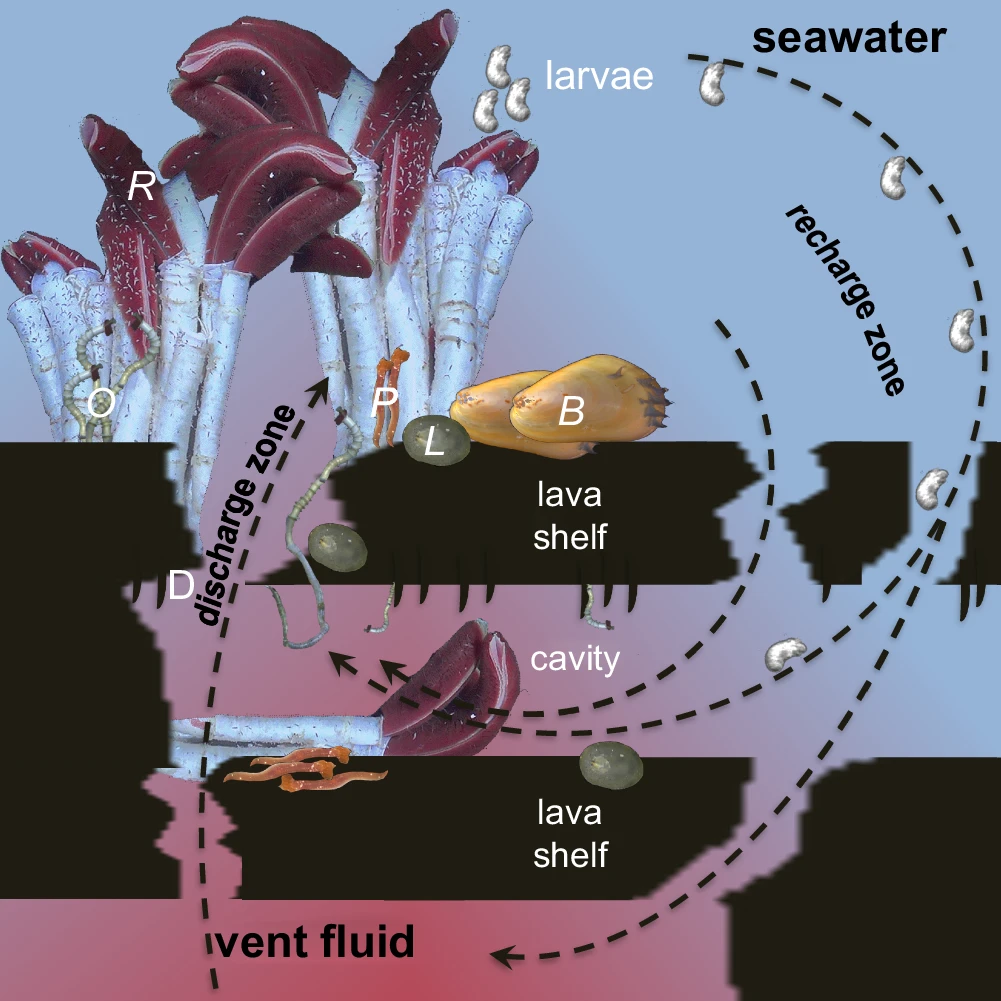
Fig. 3: Seafloor surface hydrothermal vents and respective excavation into cavity beneath lobate lava shelf. From Bright et al., 2024.
Deep-sea tube worms, Riftia pachyptila, are pretty wild. Evolved to live in the dynamic and dangerous environment surrounding a hydrothermal vent they grow quickly and propagate widely. Lacking a digestive system and completely dependent on the chemoautotrophic microbes that live within specialized organs for sustenance, they can only survive near these vents. But in the presence of a chemical-rich hydrothermal vent, they don’t just survive, they thrive.
Tube worms aren’t the only organisms that thrive around hydrothermal vents. Shrimp, mussels, crabs, squat lobsters, barnacles, octopuses, and even fish call the halo of productivity around a hydrothermal vent home. And then there are the microbes. Bacteria and archaea adapted to exploit the chemical furnace of a hydrothermal vent are found in cracks and crevices, guts and gills, rock and mud, and even within the vent chimney itself. A growing body of work exposing the deep biosphere reveals that microbes can dwell deep beneath the seafloor, living off the heat and chemical energy of the hydrothermal system.
So here’s a question: If microbes can survive in the deep places, in cracks and crevices beneath the seafloor, and animals like the giant tube worm derive all of their energy from the vent fluid, mediated by some of the same microbes, require no sunlight, don’t need to be out in the open ocean to hunt, why shouldn’t we expect find tube worms in the deep places, too?
As it turns out, they do.
In Animal life in the shallow subseafloor crust at deep-sea hydrothermal vents, published this week in Nature Communications, Bright and friends overturned slabs around hydrothermal vents in the East Pacific to reveal crevices beneath the seafloor. And in those crevices, they found tube worms.
Fig. 5: Proposed connectivity model between seafloor surface and crustal subseafloor hydrothermal vents. From Bright et al., 2024.
When giant deep-sea tube worm spawn, they broadcast their larvae into the water column. Some of those larvae become entrained in the the currents surrounding the vent and are carried carried down into the stock works. Those lucky enough to land within cavities (rather than boiled alive by the increasingly hot vent fluid) can settle out and grow just like any other tubeworm, exposed to a chemically-enrich plume of delicious hydrothermal fluid and protected from external threats on the seafloor. It seems like a pretty good deal.
What this all means is that hydrothermal vent ecosystems can extend far beyond what is visible, not just horizontally across the seafloor, but vertically down into the subseafloor biosphere. The deep biosphere, assumed to be the exclusive domain of microbes, is even more complex that previously known. And beyond that, I think there is a profound beauty in the fact that we can still fundamentally alter our understanding of what it means to be a living thing on this planet by flipping over a few rocks.
The ocean is big and weird and we are just getting started.
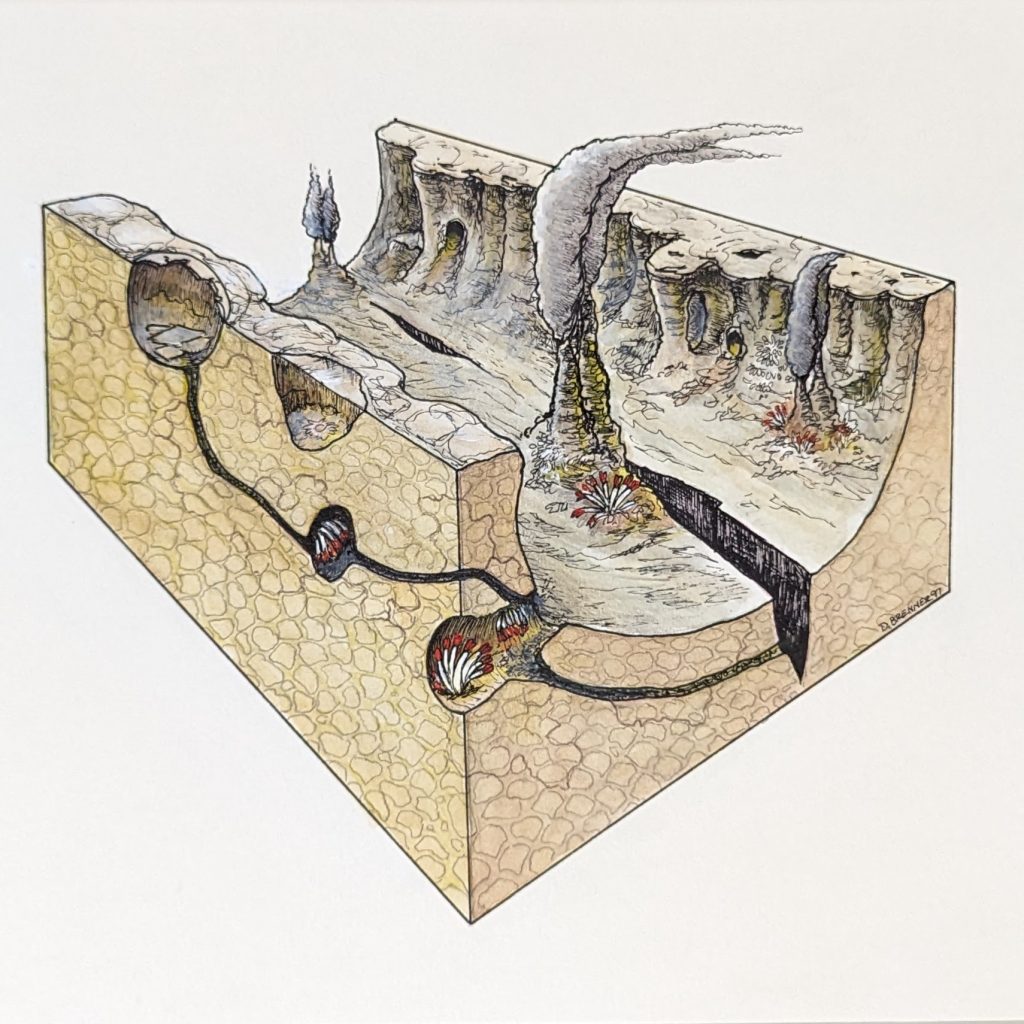
There’s a funny little coda to this discovery. In the paper, the authors provide this tantalizing note: “Transit of larvae through the shallow Earth’s crust in porous volcanic rocks, channels and small subsurface cavities has been suggested (unpublished illustration commissioned by Van Dover 1997), but has to our knowledge never been investigated.”
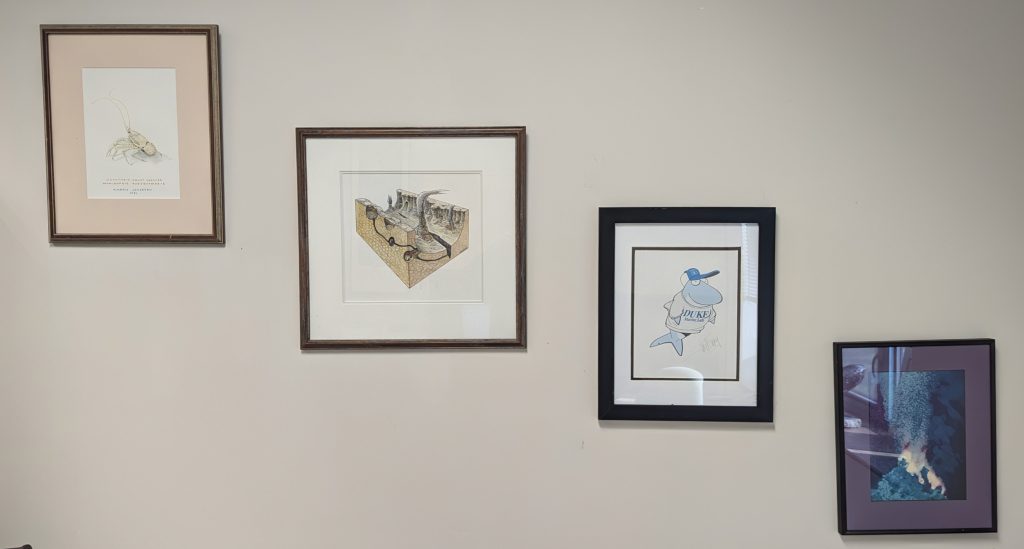
Two years ago, I took over stewardship over a large portion of my PhD advisor’s sample collection. In addition to tens of thousands of priceless biological specimens, that sample collection came with some amazing deep sea art, much of which is gracing the walls of my office at the Horn Point Lab.
A wall of ocean art, including a squat lobster, the tube worm illustration, Sherman the shark in a Duke shirt, and a hydrothermal vent emitting light.
And right there, in the middle, is an unpublished illustration from 1997 featuring giant deep-sea tube worms dwelling within the subseafloor cavities of an active hydrothermal vent field (the illustration is signed D. Brenner ’97, but I don’t have any other information about the artist).
It is a cool little piece of ocean exploration history and a reminder that the deep ocean is still full of surprises.
Southern Fried Science is free and ad-free. Southern Fried Science and the OpenCTD project are supported by funding from our Patreon Subscribers. If you value these resources, please consider contributing a few dollars to help keep the servers running and the coffee flowing.We have stickers.
Texas-based oil and gas major Energy Transfer said the company has entered into a long-term agreement with Colorado-based CloudBurst Data Centers for the energy supply to serve a data center development in Texas.
The agreement announced Feb. 10 calls for Energy Transfer to provide as much as 450,000 MMBtu per day of natural gas to CloudBurst’s flagship Next-Gen Data Center campus near San Marcos. Energy Transfer on Monday said the natural gas supply “would be sufficient to generate up to approximately 1.2 GW of direct, or ‘behind-the-meter’ electric power for a period of at least 10 years,” beginning with the first phase of development for the data center.
CloudBurst, headquartered in Denver, said its expects a final investment decision for the project later this year. The company said it expects the facility would be operational in the second half of next year.
‘Very Excited’ About Deal
“We are very excited about our close relationship with Energy Transfer and feel extremely confident in their ability to provide redundancy through their vast pipeline network and storage capacity,” said Cynthia Thompson, executive chair for CloudBurst Data Centers. “In addition, we will work closely with Energy Transfer to identify additional potential data center sites, on or close to their strategic natural gas pipeline network, using our proprietary site selection software.”
The deal is Energy Transfer’s first commercial arrangement to supply natural gas directly to a data center. The company on Monday said it “is uniquely positioned to provide reliable natural gas supply that is crucial to the data center operations under development, many of which are in close proximity to [Energy Transfer’s] vast network of more than 105,000 miles of natural gas gathering, and intrastate and interstate transportation pipelines and storage facilities with a combined storage capacity of nearly 236 billion cubic feet.
Energy Transfer said it is in discussions with several data center developers, and said it expects this agreement will “be the first of many agreements to supply, store and transport natural gas to fuel data centers, electric generation facilities and other power demand customers” throughout its nationwide footprint.
Rise in Demand for Natural Gas
Energy industry analysts have told POWER they expect demand for natural will rise to help serve the energy-intensive data center sector. Oil and gas major ExxonMobil in December of last year said it plans to build a large natural gas-fired power plant specifically to serve data centers. EQT Corp., a natural gas company operating in Ohio, Pennsylvania, and West Virginia, last fall said data center energy needs could boost U.S. natural gas demand by up to 10 billion cubic feet per day.
Yes Energy, a Colorado-based analytics firm, recently said more than 200 natural gas-fired power units are in various stages of development across the U.S., in part due to the expected demand from the artificial intelligence/data center sector. An executive with Canadian gas pipeline operator TC Energy last year said data centers would drive significant growth in demand for natural gas.
After Zomato, now Swiggy is taking the “bite” out of wait times with the launch of its new app, SNACC. The app promises quick snacks, beverages, and meals delivered in 10 to 15 minutes, and is currently available in select neighbourhoods of Bengaluru. Going forward, SNACC will be expanded to other cities in the near future.
“Introducing SNACC by Swiggy: Your Go-To for Quick Bites, Beverages and Home-Style Meals Delivered in 15 Minutes! Craving comforting home-style food or a quick snack? Swiggy SNACC brings a delightful array of freshly prepared dishes and beverages straight to your doorstep in just 15 minutes,” reads the app’s description on the Play Store.
This development comes on the heels of Zomato launching a similar venture and making a comeback into the domestic instant food delivery market (allowing users to place quick orders from nearby restaurants within a radius of 2 km). Recent years have seen a steady growth of the demand for fast food delivery services, particularly in urban centres like Bengaluru, where consumers are increasingly looking for convenience in their dining experiences. This shift is largely driven by millennials and Gen Z, who have grown accustomed to the immediacy that modern technology provides, including in the food sector.
This is where the new standalone app comes in, and SNACC is set to offer a menu that includes breakfast items, light meals, snacks, and beverages, all delivered within a short window of time. Partnerships with popular brands like Blue Tokai and The Whole Truth are featured alongside unbranded offerings sourced from third-party food providers, and the app caters to the needs of consumers who have little time to wait for food but still want access to high-quality, hassle-free meals. With the app, users will have access to all the quick-bite options, enabling them to skip the time-consuming process of browsing through extensive menus, before making their choice and placing their orders. Users in the available regions can download the SNACC app from the Google Play Store and Apple App Store.
The launch of SNACC marks a departure from Swiggy’s established business model and “one-size-fits-all” approach, in which all of its services—including food delivery, quick commerce, hyperlocal delivery, and dining-out options—were integrated into the same app. This has made navigating Swiggy quite complex and time-consuming, and the launch of separate apps can cut down on time spent browsing the overall app. It also mirrors moves made by rivals like Zepto and Blinkit, which have developed standalone apps for their rapid food delivery services, Zepto Cafe and Blinkit Bistro, respectively. Similarly, Ola has entered the fray with Ola Dash, a service offering food delivery in 10 minutes in Bengaluru, with plans for a nationwide rollout. In addition to these players, Swiggy is also up against other emerging names like Magicpin, which recently launched magicNOW, a service offering 15-minute deliveries across six major cities.
The Madison Community Arts Center has canceled this event because of internal personnel changes. Check on the status of future center events here.
From the Madison Community Arts Center:
Carolyn Dorfman Dance returns to the Madison Community Arts Center (at 10 Kings Road) with a Family Backstage Pass performance, a welcoming interactive afternoon of dance and audience participation, on Sunday, Feb. 23, 2025, at 4 pm.
It will be an unforgettable afternoon, offering a captivating glimpse into the remarkable works and process of artistic director Carolyn Dorfman. Some of the popular works will include excerpts of the crowd-pleasing WAVES, the playful duet Keystone and the comical Divide and Conquer, a work which has not been on stage for almost 15 years.
The program ends with Dorfman’s signature “building a dance” including audience members on the stage and in their seats with Carolyn and Company.
Carolyn Dorfman Dance’s stunning and athletic ensemble includes, Kayleigh Bowen, Tyler Choquette, Dominique Dobransky, Hannah Gross, Maiko Harada, Brandon Jones, Jacob Kurihara, Aanyse Pettiford-Chandler, Charles Scheland, Jared Stern; Katlyn Baskin is the rehearsal director.
The administrative staff includes Executive Director Anita Thomas, associate Artistic Director Jacqueline Dumas Albert, Company/Office Manager Zakk Ottmers, Marketing Communications Manager Armisey Smith, and Financial Administrator Flora Attardi.
Bring friends and family to Backstage Pass as the company explores the themes of family, community, and more — all brought to life by the exceptional artists of Carolyn Dorfman Dance. Secure your seats now and be part of this immersive experience. Tickets are $20 in advance ($25 the day of show.) Tickets for seniors and students 18 and under are $15. For tickets to the Madison Community Arts Center performance go here.
The Meritus School of Osteopathic Medicine (MSOM) Office of Research announces its inaugural Research & Scholarly Conference, scheduled for March 13, 2025, from 4:30 PM to 7:00 PM on the MSOM campus. This event marks the first of its kind at the institution, providing a platform for the presentation and discussion of innovative research across various fields.
Attendees can look forward to exploring a diverse range of topics, including Clinical Research & Health Systems Science, Clinical Case Studies, Basic Science & Translational Research, Population & Community Health, and Medical Education Research.
The conference offers a unique opportunity for researchers, healthcare professionals, and scholars to engage with cutting-edge studies and network with peers in the field.
For registration and additional information, visit the MSOM Office of Research’s website.