Sarla Aviation, an ambitious tech venture that aims to introduce (and make common) electric flying taxis for public transportation in India, has announced a new $10Mn Series ‘A1’ round from Accel. The round was co-led by billionaire co-founder of Zerodha, Nikhil Kamath. This Series A1 round also saw participation from Flipkart co-founder Binny Bansal and recently IPOed Swiggy founder Sriharsha Majety.
Sarla Aviation, named after India’s first woman pilot Sarla Thukral, had previously raised a seed round of $1.7Mn, also led by Accel. That round included participation from several angels, including Tata Motors CTO Rajendra Petkar.
Recent transportation reports have suggested, that India has the unfortunate distinction of having three of the top 5 most congested cities in the world. As India’s economy sees rapid expansion, so has expanded the number of vehicles on Indian roads. Public infrastructure though, has barely kept up, with many of country’s top metropolises struggling to keep traffic moving. Public transport too, is good in patches, with the exception of capital city of Delhi, as local governments struggle to cope up with the aggressively rising needs for a more robust public transport system.
Sarla Aviation is looking to bypass those congested streets, with its electric flying taxis, a first and rather novel tech innovation for India’s public transportation landscape. “In India, a shorter range is fine, as long as you can offer it at an attractive price point. And that’s what we’re trying to achieve with this higher payload,” said Adrian Schmidt, co-founder and CEO of Sarla Aviation, in an interview.
With the recently raised $10Mn, Sarla Aviation will spend more on R&D, team expansion to a headcount that is 3-4 times of what its today, and try to validate newer prototypes. A real, usable and publicly available electric flying taxi might still be some time away.
Co-founded by Adrian Schmidt (a German citizen), Rakesh Gaonkar and Shivam Chauhan, the company aims to showcase its first prototype named ‘Shunya’ (Hindi for ‘Zero’) at an event in New Delhi on January 17.
Schmidt says Sarla Aviation is expecting to start commercial operations for airport transfers in Bengaluru soon, and gradually roll into Mumbai, Delhi, and Pune. It also plans to launch a free air ambulance service parallel to commercial ride-sharing services in its first phase.
The startup is planning to price its air taxi ticket in parallel to the top price of an Uber or Ola cab in the country. They gradually expect the price to come down to the fare Indian riders typically pay for an auto-rickshaw over time.
The Women’s Association for Morristown Medical Center has found another diamond in the rough.
Wildfair, a 250-year-old estate on 33 acres in Chester, has been chosen for this year’s Mansion in May. After 50 years and 20 mansions, the association’s springtime show houses are an eagerly anticipated tradition– and the signature fundraiser for the nonprofit, which has raised more than $14 million for the hospital over the years.
Pam Epifano, owner of Wildfair, Jan. 16, 2025. Photo by Kevin Coughlin
Wildfair is a rambling stone structure with many reincarnations, starting as a working farm with a gristmill and sawmill and, most recently, becoming home to the Epifano family.
“We’ve been working on it for a little over a year,” Pam Epifano said during a media preview tour, on a grey, chilly morning last month. “It’s very much a family adventure.”
Although they have not yet moved into the house, her three sons, ages 24-29, have taken the lead in returning the property to its roots. They’ve started by changing its name from Fox Chase Farm back to the original Wildfair. They have a more ambitious plan to restore its agricultural productivity as well.
Wildfair BEFORE its May 2025 transformation. Slideshow photos by Kevin Coughlin. Click/hover for captions:
“We have bees and chickens and we’re already farming the land,” Epifano explained. She described how the boys are planting chanterelle and other specialty mushrooms in the woodlands, and making use of maple and hickory trees for edible products and firewood.
Epifano is at Wildfair almost every day. Hands-on and very enthusiastic, she regularly confers with the 38 design firms that are transforming every room in the house for Mansion in May.
Wildfair, site of Mansion in May 2025. Jan. 16, 2025. Photo by Kevin Coughlin
The Kitchen, or Shokukai (translated as “food gathering”), is her bailiwick. On the preview day, the Shokukai (room 12 in the program) was strewn with faceless cabinet boxes and a mood board. Very few clues were offered for what will follow in the spring.
Looking straight out from out from the kitchen island and separated by a two shallow steps is the Great Room, room 11, by Rachel Kapner of CWI Designs. The largest room in the mansion, the vast space has a stone wall at the far end, large windows on both sides, and a barrel-vaulted ceiling covered in natural wood. When completed, the kitchen and great room will likely be the heart of the home.
On the left side of the kitchen, visitors will find Breakfast Room, number 13, by Hanna Goldberg of Hanna Charlotte Interiors. Small and cheery, it was in the process of being tiled. Just a few steps away, the mood changed abruptly.
Arlene Riley of Bernards Decorators has her work cut out for her in the Mud Room (number 15), a windowless and, arguably the most derelict, room in the mansion. It adjoins the even more depressing Laundry Room (no. 16), undertaken by Stephanie Barbara of Lily and the Rose Design. Good luck ladies!
Samples of paper, paint and fabric, along with drawings and photographs, aided designers as they described their projects. Kristin Badolato of Kristin Ashley Interiors offered a bit more, with a large sample of exquisite Gracie chinoiserie wallpaper, destined to line the walls of the Dining Room. It was easy to imagine the large, sunlit space will be a knockout.
Several rooms have existing cherry cabinetry that Epifano chose to preserve intact. Among them is the dramatic Upper & Lower Library (room 7), by Karla Trincanello of Interior Decisions.
The ground floor and basement are connected by a sharply curved staircase. It’s an unusual and intimate configuration that takes advantage of warm toned cherry paneling to set the mood. The lower level will be transformed into a seating area around an existing fireplace, surrounded by fabric and carpeting with an animal theme, and book-filled shelves.
THE TRANSFORMATION BEGINS. Wildfair, Jan. 16, 2025. Photo by Kevin Coughlin
Another example of cherry millwork can be found at the other end of the house, in The Office (room 4), by M. McDevitt and J. Turner of Elements Interior Design Studio. The designers named it I Take my Whiskey Neat, and plan to fill the shelves with a variety of adult beverages and compatible accessories.McDevitt and Turner said visitors should not expect samples. But you never know.
Despite major renovations and expansions, most recently in 1934 and again in the 1990s, Epifano said much work remained. “The property needed a lot of love.
“The house was empty for several years when we bought it. A couple of chimneys had to be taken down and rebuilt, new windows installed, and seven new heating systems had to be installed,” she said, dressed in working clothes for the tasks ahead.
The aptly named Great Room will have ample space for dancing. Wildfair, Jan. 16, 2025. Photo by Kevin Coughlin
One might expect Epifano to feel overwhelmed by the restoration. Not at all. She has more than a few such projects under her belt.
The Epifano family owns Epic Management and Construction, with a portfolio that includes residential projects and major commercial properties such as Rutgers Stadium (now known as SHI Stadium) in Piscataway, the Mansion at Natirar in Peapack, and Temple B’nai Jeshurun in Short Hills.
Proceeds from Wildfair Mansion in May are earmarked for a MEVION S250-FIT Proton Therapy System™ to be unveiled at Morristown Medical Center’s Carol G. Simon Cancer Center in 2025.
According to the hospital, proton therapy is an advanced cancer treatment that targets tumors with sub-millimeter precision, leaving healthy cells intact. It is performed on an outpatient basis and takes a few minutes per session. Non-invasive and painless, it allows patients to live normally during their treatment, a giant step forward in radiation therapy.
Wildfair will open to the public from May 1 to May 31, 2025. Tickets are $50 before May 1, and $55 after. Individual private tour tickets go on sale on March 1, 2025. Select designer items also may be purchased by the public.
Keystone Pharmacy is now offering free prescription delivery for anyone within a 10-mile radius, ensuring that individuals do not need to venture out in harsh winter weather to pick up their medications. This service is available to all, regardless of whether they are patients at other Keystone Health practices.
For more information or to sign up for this convenient service, please contact Keystone Pharmacy at (717) 709-7977.
There’s a growing trend that’s both alarming and detrimental to the software development industry: clients with wildly unrealistic expectations, expecting to pay mere hundreds of pounds for projects that should cost many times over that amount. It’s a trend we encounter all too often, and one that leads to disappointment and frustration on all sides.
Take my “favourite”(it’s not something I like I find it bloody terrifying being honest) example this week: a client approached us asking for “an app like Uber for £100” – let that sink in.
Uber, one of the most complex and high-performing platforms in the world, with millions in development and eye-watering running costs, and somehow, the expectation was to replicate this for pocket change. Of course, these magic get-rich-quick schemes don’t exist. What does exist, however, is a dangerous culture of unrealistic expectations.
A Distorted Understanding of Costs
To give some perspective, here’s a breakdown of average hourly ratesfor a Software Developer (I’ve chosen this level for comparison purposes and please remember those with less or more experience will cost differing amounts at their career levels but you will get the idea) across the world:
Country
Average Range (GBP)
Argentina
£25 – £45
Bangladesh
£15 – £25
Belarus
£25 – £40
Brazil
£20 – £40
Bulgaria
£30 – £50
China
£20 – £40
Colombia
£20 – £35
Egypt
£15 – £30
Hungary
£35 – £55
India
£15 – £35
Kenya
£15 – £25
Mexico
£25 – £40
Pakistan
£15 – £25
Philippines
£20 – £30
Poland
£35 – £60
Romania
£30 – £50
South Africa
£25 – £40
Ukraine
£25 – £45
United Kingdom
£50 – £120
Vietnam
£15 – £30
2024 Average hourly rates for a Software Developer
When you see these figures, the idea that you can build a complex, high-functioning app for £100 seems absurd, but it’s a reality we face as tech providers. Clients are increasingly drawn to low-cost development centres that stack their teams with underpaid, low-skilled developers, exploiting both clients and staff in the name of profit.
The “Race to the Bottom” Culture
These low-cost development centres contribute to a “race to the bottom”—a culture where quality is sacrificed in favour of cost-cutting. Clients are often lured by the promise of cheap development but end up with shoddy deliverables. The appeal of saving money up front is overshadowed by the long-term costs: delayed timelines, buggy software, and missed opportunities.
Even worse, this culture sets up conflict from the outset. Clients expect “Uber-like” solutions on shoestring budgets, and when those expectations are inevitably not met, developers are left scrambling to deliver anything at all while trying to protect their own cash flow. This creates a toxic environment where neither side wins.
Our CTO, Mike Blamires, sums it up best: clients are after “Michelin star food at McDonald’s prices.” This mindset isn’t just flawed—it’s damaging to the industry. Quality, innovation, and trust are sacrificed when clients and developers engage in this race to the bottom.
The Consequences for Clients
The cost of choosing the wrong tech partner is steep. Clients who go for the cheapest option are setting themselves up for failure. The consequences are clear:
Poor quality deliverables: Cheap development often leads to poorly built solutions that can’t scale or meet business requirements. Often they don’t even work at all! We’ve been working with one unfortunate client who had previously engaged another “provider” and they had been charged $25,000 and didn’t have a single working page! How would you feel if this was you?
Delays and missed deadlines: Rushed, low-cost development teams don’t have the capacity to manage complex timelines
Higher long-term costs: A “bargain” solution often needs to be rebuilt from the ground up, costing far more than a high-quality solution would have in the first place
Frustration and dissatisfaction: When expectations are wildly out of line with reality, clients are left disappointed, while developers struggle to deliver under impossible constraints
The Broader Impact on the Industry
Unrealistic budgets often result in a cycle of frustration, wasted time, and missed opportunities for both clients and tech providers. When clients approach a project with budgets that don’t align with the scope or complexity of their goals, the business development phase can quickly become a series of painful negotiations and resets. The back-and-forth that ensues isn’t just about bridging a budget gap—it’s a conversation that reveals misaligned expectations and ultimately stalls progress and for tech providers results in “wasted” non-chargeable time.
For the client, this can be an exhausting process. Weeks or even months can be spent searching for providers who might fit within a limited budget, only to discover that cutting costs often means cutting essential features, quality, or timelines – worse still many are left to believe that their expectations are being met only to find our the truth down the line.
Providers, in turn, face a similar struggle. While they want to deliver value and meet client needs, an unrealistic budget forces them to compromise on quality or turn down work altogether. These are missed opportunities for both sides, where meaningful projects never get off the ground simply because the financial expectations were misaligned from the start. I don’t think it’s surprising that many providers will table something just to get some cash through the door and deal with the fallout down the line!
This cycle of negotiating down can also damage trust and tarnish relationships before the project even begins. Providers are less inclined to go the extra mile when they sense a lack of alignment, and clients may lose faith in the provider’s ability to deliver if they sense too much pushback on cost. Ultimately, unrealistic budgets prevent both parties from focusing on what truly matters: creating solutions that drive real value. When budget expectations are set realistically from the outset, both clients and providers can work toward the same goals, fostering a smoother business development process and setting the project up for success.
A Call for Realistic Budgets and Better Due Diligence
Clients need to have a harsh reality check. Building quality tech that meets your business goals by delivering real value isn’t cheap, and it certainly isn’t fast. When you start by underbudgeting or expecting premium results on the cheap, you’re setting your project up for failure before it even begins.
If you’re serious about creating a tech solution that works, then you need to do your due diligence:
Understand the true cost of development. Good developers are professionals who deserve to be paid for their expertise
Be realistic. If your project is complex, it will take time and money to do it right
Trust your tech partner. You’re hiring experts, so be open to their advice on scope, timelines, and budget
Understanding the True Costs of Quality Software Development
When selecting a software development partner, it’s critical to understand the true cost of quality—especially when you’re working with top-tier talent. Choosing the cheapest option often results in subpar outcomes, but engaging developers from the top 25% of talent ensures the best results, albeit at a higher cost. Here’s what I believe the real rates look like for the most skilled software engineers across common development centers, and how much you should realistically budget for different project sizes:
Country
True Hourly Rate (Top 25%) (GBP)
Small Project Estimate (GBP)
Medium Project Estimate (GBP)
Large Project Estimate (GBP)
Argentina
£45 – £65
£45k – £65k
£100k – £160k
£250k – £400k
Bangladesh
£35 – £55
£35k – £55k
£85k – £140k
£200k – £320k
Belarus
£45 – £65
£45k – £65k
£100k – £160k
£250k – £400k
Brazil
£40 – £60
£40k – £60k
£90k – £150k
£220k – £360k
Bulgaria
£50 – £75
£50k – £75k
£120k – £200k
£300k – £500k
China
£40 – £60
£40k – £60k
£90k – £150k
£220k – £360k
Colombia
£40 – £60
£40k – £60k
£90k – £150k
£220k – £360k
Egypt
£35 – £55
£35k – £55k
£85k – £140k
£200k – £320k
Hungary
£55 – £85
£55k – £85k
£130k – £220k
£320k – £550k
India
£40 – £60
£40k – £60k
£90k – £150k
£220k – £360k
Kenya
£35 – £50
£35k – £50k
£85k – £130k
£200k – £300k
Mexico
£45 – £65
£45k – £65k
£100k – £160k
£250k – £400k
Pakistan
£35 – £55
£35k – £55k
£85k – £140k
£200k – £320k
Philippines
£40 – £60
£40k – £60k
£90k – £150k
£220k – £360k
Poland
£55 – £85
£55k – £85k
£130k – £220k
£320k – £550k
Romania
£50 – £75
£50k – £75k
£120k – £200k
£300k – £500k
South Africa
£45 – £65
£45k – £65k
£100k – £160k
£250k – £400k
Ukraine
£45 – £65
£45k – £65k
£100k – £160k
£250k – £400k
United Kingdom
£90 – £170
£90k – £170k
£220k – £400k
£500k – £800k
Vietnam
£35 – £55
£35k – £55k
£85k – £140k
£200k – £320k
Estimated 2024 Developer costs across “Top 25%” Providers
Project Size Breakdown:
Small Projects: Typically MVPs or basic applications, lasting 2-3 months
Medium Projects: More complex applications with additional features, integrations, and custom functionalities, lasting 4-6 months
Large Projects: Comprehensive software solutions with high complexity, integrations, and scalability needs, lasting 6-12+ months
Why This Matters
By opting for developers in the top 25% of the talent pool, you ensure your project will be handled by skilled professionals who can deliver a product that’s scalable, secure, and efficient. But this also comes with a price tag that reflects the value of their expertise.
Cutting costs by engaging lower-tier developers often leads to poor quality, missed deadlines, and higher long-term expenses, as you’ll likely end up paying for costly fixes and reworks. As you consider offshore or nearshore teams, it’s important to set realistic budgets and focus on quality over cost.
For more insights, check out some of our other posts on the topic:
Atomise’s Approach: Unlocking Value and Enabling Progress with Realistic Solutions
At Atomise, we know that successful technology isn’t born from magic—it’s built with smart, thoughtful planning and expertise. We won’t promise you an “Uber-like” solution for under £100, but we can deliver valuable, impactful tech solutions designed to fit your needs and budget. Our approach is all about unlocking value, even for projects with tighter budgets, and helping businesses take meaningful first steps without overextending financially.
Our consultative approach starts with an upfront conversation about your goals, challenges, and budget. We work closely with you to break down your vision into achievable, bite-sized deliverables that generate traction and value. By leveraging Proof of Concepts (PoCs) and Minimum Viable Products (MVPs), we help clients begin their tech journey in a manageable, cost-effective way. PoCs allow us to test key aspects of a solution, helping you see what’s possible without committing to full-scale development. With MVPs, we deliver essential features that let you validate ideas, gather feedback, and adjust as needed—all without needing a massive budget upfront.
This strategic, incremental approach means businesses don’t have to go all-in to start seeing results. By focusing on early wins and gradual scaling, we provide a clear, manageable path forward that aligns with both your ambitions and your budget. At Atomise, we’re here to make sure that ambition and budget go hand-in-hand, delivering real solutions that drive value, build confidence, and lay the groundwork for future growth.
Challenging the Status Quo: Raising Standards with Transparency
What I’ve written here may cause some discomfort among tech providers, and I get it—this approach opens a can of worms. But our commitment at Atomise goes beyond simply delivering solutions; we’re here to raise the standards of our industry. Many tech providers might balk at the idea of pulling back the curtain on budget realities and project risks, but we believe our clients deserve transparency, clarity, and honesty. That’s why one of our core values is transparency—we are dedicated to shining a light on the practices, challenges, and true costs that shape successful projects.
We’re challenging both clients and providers to work together in setting realistic expectations, aligning on goals, and driving toward outcomes that aren’t just about the bottom line but about genuine, long-term value. The more openly we address these issues, the better equipped we are to avoid misaligned expectations and to develop projects that succeed from the start.
Our commitment to raising industry standards is part of everything we do, and we’re not afraid to call out practices that undermine client success. We invite other providers to join us in this mission, pushing for higher standards across the board. Ultimately, this approach benefits not just clients and providers but the industry as a whole, fostering an environment where quality, trust, and true partnership lead the way. At Atomise, we’re here to champion this approach because we believe that tech, when done right, is a transformative force for good.
Anupa Asokan, founder and executive director of Fish On—a new fishing interest organization working to advance ocean conservation policy—recently published a peer-reviewed perspective in Frontiers, “Marine Protected Areas as a Tool for Environmental Justice.”
Anupa is a lifelong fisherwoman and has become a passionate advocate for ocean conservation and justice. I’ve known her for several years, and shared the stage with her at the first Upwell conference in Washington, DC in 2023.
Anupa Asokan speaking at Upwell
She sat down with me recently to answer 5 questions about her new paper on environmental justice. Here’s a transcript of that conversation (edited for length and clarity):
Angelo Villagomez: Congrats on the paper! What a great way to start the new year. Where does this rank in terms of your career accomplishments?
Anupa Asokan: Thank you! To be honest, while this definitely feels like a highlight worth celebrating, I don’t know that I’ve stopped to think about my career accomplishments in this way. My career has felt more like a winding road (or maybe a rollercoaster!) of discovering how I can best contribute to the issues I care about. For me, this paper helped chip away at an obstacle I felt like I was constantly up against in my advocacy work. It articulates viewpoints I’ve developed through my career and life experiences to date, and (I hope) also offers something we as an ocean conservation community can reference and build on moving forward.
Angelo: I understand this is your first scientific paper. What was going through the peer review process like, and why did you decide to focus on the topic of environmental justice and marine protected areas (MPAs)?
Anupa: My first connection to the ocean was through fishing. I don’t exactly fit the stereotype of a fisher, but it’s something I still do regularly and it has shaped my approach to advocacy. People of color and women are grossly underrepresented in ocean management and I see opportunity to support people that look more like me in the fishing community. MPAs are the quintessential topic that pits fishing against conservation, but as a fisherwoman I see their value, and as a scientist I understand the opportunity MPAs present for conservation.
There is rightful criticism of parachute approaches to conservation. And there is a lot of literature out there discussing the ramifications to communities around the world where this approach has taken place. In the U.S. however, the context of our ocean policy and management is lost in that argument. There are real opportunities to support marginalized communities through meaningful conservation, but not enough research that explores what that looks like. I spent so much time trying to put the ideas in this paper under the U.S. policy context that I missed the potential for these ideas to be relevant in other places. The peer review process helped this emerge and helped me see other gaps and potential opportunities in the ideas presented.
Angelo: A lot of the scientists and ocean advocates I’ve known over the years talk about the importance of using science to make ocean decisions – and I’m assuming most of the readers of this blog accept that as a cornerstone of the conservation movement. You write that “social context is often presented as burdensome.” Can you explain what you mean by that?
Anupa: You once told me that the villains in superhero stories are also science-driven! Science can be used for good or for evil; it’s our values that drive how we interpret and apply that information. Our vision of what the future of the ocean should look like is what ultimately defines our values and underpins the policies we advocate for.
A common argument against conservation policies is that they are a burden to the people that rely on something for their livelihoods. There are examples of outsiders trying to establish a protected area somewhere else in the world without understanding how they will truly impact a local community. But I found this idea repeatedly misrepresented and used by the fishing industry here in the U.S. to undermine potential or existing MPAs that have benefited local communities, including fishing communities. Without understanding the enabling conditions, I think it’s unfair to trivialize all MPAs as burdensome to communities.
Angelo: Some people have been talking about these “enabling conditions” you mention for many years. What are those and why are they important to ocean conservation?
Anupa: In conservation policy, I see the “good vs. evil” trope boiling down to protecting the planet for everyone for the long term, or using up what we have right now. In reality, we have a spectrum of options somewhere in the middle of that. And we have the context that influences which option we choose—data, science, policy, anecdotes, people and their needs, how information is presented to people, political will, and so on. In academic circles, that context is what we call “enabling conditions,” which, essentially, are the circumstances and the details that make an MPA work or not.
Angelo: And what’s the next step for this work, not just for you, but for the national conservation movement?
Anupa: I just started a new conservation organization called Fish On. My goal is to educate and empower other fishers to step into the conservation movement. It’s time to break the stereotype of what a fisherman looks like and more importantly, what we value. I hope that the conservation movement—and the ocean—will be better for it.
To learn more about Anupa’s work you can follow her on Bluesky or LinkedIn.
Angelo Villagomez is a senior fellow with the Center for American Progress, where he focuses on Indigenous-led conservation and ocean justice.
Researchers from Duke University have said that integrating more flexibility into U.S. power grids could help provide the energy needed to power future load growth, particularly the electricity needed to support artificial intelligence and data centers.
The group in a Feb. 19 webinar discussed their findings, which are contained in their recent report titled “Rethinking Load Growth: Assessing the Potential for Integration of Large Flexible Loads in US Power Systems.” The report comes from Duke’s Nicholas Institute for Energy, Environment & Sustainability.
The study was coauthored by Tim Profeta, senior fellow at the Nicholas Institute and associate professor of the practice at the Duke University Sanford School of Public Policy; Dalia Patiño-Echeverri, associate professor at the Nicholas School of the Environment; Tyler Norris, a Ph.D student at the Nicholas School of the Environment; and Adam Cowie-Haskell, a graduate student at the Nicholas School.
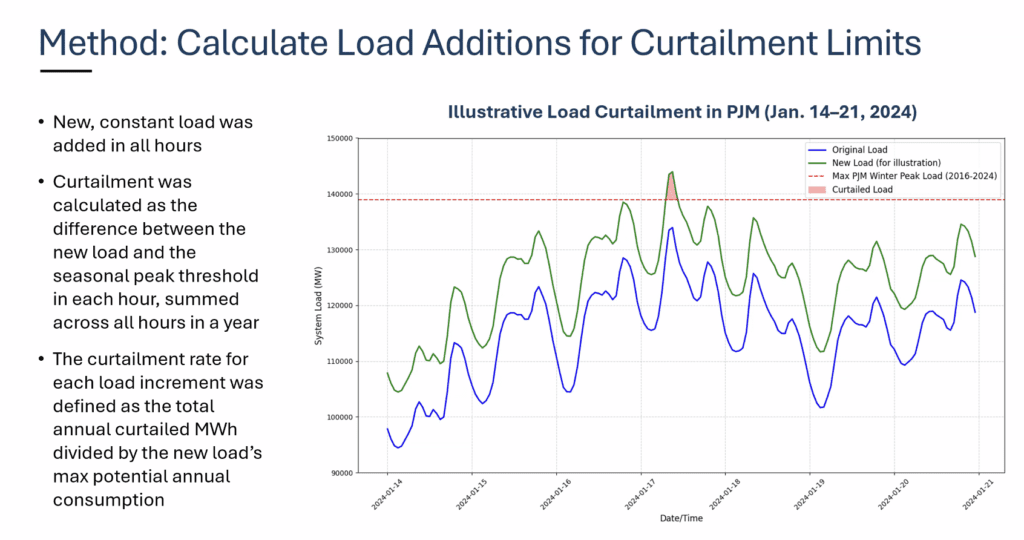
The study looked at 22 of the nation’s largest balancing authorities, which together serve about 95% of the country’s peak power load. The researchers said that gigawatts of new load could be added to the U.S. grid in each balancing authority before the total load would surpass what system planners are prepared to serve. The key point of the study is grid flexibility, so that the new load can be temporarily curtailed as needed to avoid problems with power delivery.
Profeta said, “I think we’re really looking to use this analysis to inform the relevant decision-makers regarding how we service loads. That’s the regulators at the state level, at the regional level, and also the sources of load, and also the utilities, the federal policy-makers overseeing the system. I think that’s all relevant, but I think what we really want to do is introduce a process, to use this headroom in planning processes.”
Profeta added, “And then possibly maybe provide motivation for regulators to open proceedings to explore recommendations for how they should potentially enable this approach across their entire planning process. This [load growth] is presenting unique challenges to regulators. We want to show how flexibility can mitigate these additional loads.”
Curtailing Loads
The study found that 76 GW of new load, which is equivalent to about 10% of the nation’s current aggregate peak demand, could be integrated with an average annual load curtailment rate of 0.25%. In other words, that would mean new loads can be curtailed for 0.25% of their maximum uptime. The group also said that 98 GW of new load could be integrated at an average annual load curtailment rate of 0.5%, and 126 GW at a rate of 1.0%.
The report said the five balancing authorities with the largest potential load integration at 0.5% annual curtailment include PJM (Figure 1), which serves 13 states and the District of Columbia, at 18 GW; and the Midcontinent Independent System Operator, or MISO, which serves much of the Midwest, at 15 GW. The study said ERCOT, which oversees the Texas grid, could curtail 10 GW. The Southwest Power Pool, or SPP, serving the Southwest U.S., also could curtail 10 GW, while Southern Co.—the group that oversees several utilities in the Southeast U.S.—could curtail 8 GW.
Figure 1 – Source: Duke University / Nicholas Institute for Energy, Environment & Sustainability
Norris said, “Our study demonstrates that existing U.S. power system capacity—intentionally designed to handle extreme peak demand swings—could accommodate significant load additions with modest flexibility measures. Overall, the findings suggest that load flexibility offers a promising near-term strategy for regulators and market participants to more quickly integrate new loads, reduce the cost of capacity expansion and enable greater focus on the highest-value investments in the electric power system.”
The study said the average duration of load curtailment would be about 1.7 hours at 0.25%, 2.1 hours at 0.5%, and 2.5 hours at 1.0%. The group said about half of the new load on the grid would be retained during about 90% of the time that curtailment is required.
“There’s gold in the hills, and we should be hunting for it,” said Profeta. “Load growth is really on a collision course with the grid … it’s really intensified with the rise of AI [artificial intelligence] and data centers. We need every tool in the toolkit to address this problem, and we need every tool to address the delays we might see.”
Georg Rute, CEO of Gridraven, a company focused on optimizing the power grid, noted it’s important to recognize the challenges that exist along the grid. “While the Duke study highlights that the existing U.S. power grid has significant untapped capacity, it doesn’t address existing transmission constraints that can limit power delivery. Congestion is a problem, so a majority of the potential could easily be wiped out if that’s taken into account,” said Rute.
Rute told POWER, “However, there are readily available solutions to reduce congestion and unlock that potential. For example, even a slight wind blowing around 4 mph can increase transmission line capacity by 30% through cooling. In Germany, grid operators have implemented sensor-less dynamic line ratings (DLR) across their networks, boosting capacity and saving billions in congestion costs. Combining flexible connections with DLR is a critical step to ensure we can power AI data centers without overwhelming the grid.”
Importance of Flexibility
Profeta said the Duke group “particularly wanted to look at load flexibility to see whether it could be a near-term solution to handle load growth in this country amid some of the [grid] constraints. We wanted to look at how we can stabilize the grid while handling this load growth.”
Norris noted that load factors during the winter were on average lower than during summer months (Figure 2). “The highest demand occurs during a very short period of hours … during extreme weather events, or the hottest parts of summer or the coldest parts of winter,” said Norris. “Our systems are planned around these peaks. It’s assumed that when new load is added, it will happen during those extreme events.”
Figure 2 – Source: Duke University / Nicholas Institute for Energy, Environment & Sustainability
The group said those periods are when flexibility (Figure 3) would be important, as end-use customers could temporarily reduce their electricity consumption from the grid through the use of on-site power and energy storage, temporal flexibility, spatial flexibility, and reduced operations.
Norris said some utilities and other groups already are making adjustments to account for power demand from data centers. American Electric Power (AEP), which last fall said it expects to bring 4.7 GW of new data center capacity online this year, wants new data center customers to pay for a minimum of 85% of the energy they say they need each month, even if they use less, to cover the cost of infrastructure required to bring electricity to those facilities.
Figure 3 – Source: Duke University / Nicholas Institute for Energy, Environment & Sustainability
Norris noted that AEP has said it expects 30 GW of new load from data centers in the next few years. Bill Fehrman, CEO of Ohio-based AEP, last week said “It continues to be full speed ahead” for his group, and said the company is considering adding $10 billion to its record $54-billion capital expenditure plan through the end of the decade.
Demand Response
The study noted that the number of hours during which curtailment of new loads would be necessary each year, on average, is comparable to the curtailment from existing U.S. demand response programs. The group said their research suggests the U.S. grid is sufficient to accommodate significant constant new loads, as long as those loads can be safely scaled back during some hours of the year. They also said there is the potential to use flexible load to complement investments in new power capacity, enabling the grid to grow while also mitigating the need for large expenditures on new capacity.
The researchers, citing the North American Electric Reliability Corp.’s 2024 Long-Term Reliability Assessment, said that aggregated U.S. winter peak load is forecast to grow by 21.5% over the next 10 years, from the 2024 total of 694 GW to 843 GW by 2034. The group said demand from large commercial customers, including data centers, would be responsible for much of that load growth.
Norris during Wednesday’s webinar was asked how load flexibility could be translated into system planning processes, such as interconnection studies and resource adequacy studies that actually allow for using the headroom on the transmission and distribution system.
“This is a really important point,” said Norris. “I want to emphasize that because we’ve been asked … how is this different from existing demand response programs. The existing demand response programs, and they’ve obviously made very meaningful contributions in some markets, is that most of the loads that participate, especially the large loads—which are about 70% of participants in demand response programs—most of those loads are treated as firm loads for the purposes of resource adequacy planning and interconnection and transmission planning. And they opt to participate in demand response for economic purposes given the associated economic incentives.”
Norris continued, “What we’re talking about here can include that, but it’s a little different that we’re talking about pulling up the considerations earlier in the planning process from the beginning and recognizing the profile of the load and its capabilities before an interconnection study. And [then] a transmission study and a capacity expansion plan is developed to accommodate that new load. And that is, we think, a bit different than the existing programs we’ve seen, and it does arguably require a little bit more of a sophisticated approach to system planning.”
One97 Communications, the parent company of Paytm, has now released its financial results for the third quarter of fiscal year 2024-25. For the three months ended December 2024, the firm noted a net loss of ₹208.3 crore, marking an improvement from the ₹219.8 crore loss recorded in the same quarter the previous year. Alongside this, the firm’s revenue clocked a quarterly growth of 10% to amount to ₹1,828 crore. However, it also marks an annual decrease in revenue – the firm had clocked ₹2,850 crore in revenue in Q3 FY24.
“In Q3 FY 2025, we achieved 10% QoQ revenue growth, due to increase in GMV, healthy growth in subscription revenues and increase in revenues from distribution of financial services. Growth in net payment margin was largely on account of higher subscription revenue. Payment processing margin continues to remain in the guided range. Higher Financial Services revenue was on account of higher share of merchant loans, higher trail revenue from Default Loss Guarantee (DLG) portfolio,” Paytm announced in its official release.
Paytm’s digital payments business continued to be one of the primary drivers behind the firm’s performance – the segment has long been the cornerstone of Paytm’s operations and has shown signs of recovery after a challenging period. Revenue from the payments business increased by 8% compared to the previous quarter, reaching ₹1,059 crore. This growth was largely driven by a higher number of merchant subscriptions and a rise in the gross merchandise value (GMV) processed through Paytm’s platform (the GMV grew by 13% from the previous quarter to amount to ₹5 lakh crore).
Paytm’s financial services business also saw impressive growth in Q3 FY25. Revenue from this segment grew by 34% on a sequential basis, totaling ₹502 crore. This surge was attributed to several factors, including the increase in merchant loans, improvements in collection efficiencies, and higher income from its Default Loss Guarantee (DLG) portfolio. In addition to this, Paytm disbursed ₹3,831 crore in merchant loans during the quarter.
Coming to its other financials, the firm’s EBITDA for the same period (before ESOP), amounted to ₹41 crore, while the net payment margin grew by 5% on a quarterly basis to amount to ₹489 crore. Its total expenses for the quarter amounted to ₹2,219 crore as well, primarily driven by lower employee benefit costs and marketing expenditures. Paytm also sold its stake in PayPay Corporation, a Japanese payments firm, for $280 million (₹2,372 crore) – a development that bolstered its cash reserves, which grew to ₹12,850 crore by the end of December 2024.
“India’s large base of micro, small and medium enterprises (MSME) present a significant opportunity for mobile payments and distribution of financial services. As the leading player in India’s merchant acquiring network, we are uniquely positioned to capitalize on the vast and growing market. To further strengthen our market leadership, we are committed to launching innovative, first-of-its-kind payment devices and solutions tailored to diverse merchant needs. Our extensive distribution and service network positions us well to capitalize on this growing market. We believe that tier-2 and tier-3 cities offer significant penetration opportunities and we will further expand our distribution network to onboard more merchants from these markets,” Paytm noted in its earnings release.
Greater Morristown offers an eclectic array of events this weekend.
Scroll down for details. Check our handy calendar for even more activities–and add your own events, too.
THURSDAY: FEB. 20, 2025:
Free yoga continues at 10 am to the Morristown & Township Library. At One Miller Road, Morristown.
Morris Arts hosts a closing reception for its Artistic Facets exhibition, from 5 pm to 8 pm at The Atrium Gallery, in The Morris County Administration and Records Building in Morristown. Free. Remarks at 7:15 pm on the 5th floor. The exhibit features more than 160 artworks by 11 artists. At 10 Court St.
The Morristown & Township Library celebrates Jane Austen’s 250th birthday with a free screening of Love & Friendship (2016) at 6:45 pm. At One Miller Road, Morristown.
At 7 pm, the Macculloch Hall Historical Museum in Morristown presents a free Zoom talk, A Taste of History at Home: Apple Pudding with Orange and Rose. The museum’s Cynthia Winslow will show how a 19th century family prepared this dessert. The recipe, including an ingredient list, will be emailed to participants prior to the program. Register here.
Ever fancied taking a cruise? Learn more at a free talk, Viking Night Sip & Sail, at 7 pm at the Shakespeare Theatre of New Jersey in Madison. Registration required. At 36 Madison Ave.
FRIDAY: FEB. 21:
The Morris Plains Rotary Club meets at 7:45 am at Uncle Giuseppe’s Market. Fee: $15, includes all-you-can-eat buffet. All are welcome. Betty Dangler of the Dangler Funeral Home will talk about grief, bereavement, and how to work through it. At 1171 Route 10 (eastbound), in the upstairs room.
At 7:30 pm, the Folk Project’s Troubadour series presents Gathering Time with Bett Padgett. Admission: $15-$20; children 12 and under, free. Livestream: $10. At 21 Normandy Heights Road, Morris Township.
Gathering Time
The Madison Community Arts Center in Madison hosts a 7:30 pm Summit Film Society screening of Sing Sing. At 10 Kings Road.
SATURDAY: FEB. 22:
A busload will depart at 8 am from the Ukrainian American Cultural Center in Whippany for a 2 pm pro-Ukraine rally in Washington. Call 973-294-6225 for more.
The Morristown & Township Library hosts Indoor Qigong at 9:30 am. Free. No experience or registration required. Upstairs in the F.M. Kirby Gallery, at One Miller Road, Morristown.
The Mayo Performing Arts Center presents The Gazillion Bubble Show, at 11 am, 2 pm and 5 pm. Tickets: $31-$58. At 100 South St., Morristown, 973-539-8008.
United Voices Morris presents Pride in Progress: A Community Conversation,from noon to 4 pm at the Morristown United Methodist Church. Register here.
The Rev. Sasha Ostrom.
The Morristown Unitarian Universalist Fellowship (MUUF) in Morris Township invites the public to its 4 pm installation of the Rev. Sasha Ostrom as its fifth settled minister. The ceremony will be followed by a celebratory reception in Chu Hall. At 21 Normandy Heights Road. RSVP here.
At 7 pm, the Madison Community Arts Center hosts its monthly Come Original Showcase, featuring local musicians. Admission: $10-$15. At 10 Kings Road.
Drew University in Madison presents The Chamber Music Society of Lincoln Center performing a program of Mozart and Mendelssohn, at 7:30 pm. Tickets: $60. At 36 Madison Ave., (212) 875-5788.
The Chamber Music Society of Lincoln Center
SUNDAY: FEB. 23:
The Morris Winter Market at Convent Station commences at 9:30 am, and will return virtually every Sunday through April 27, 2025, from 9:30 am until 1 pm. Presented by Grow It Green Morristown.
Morristown photographer Frank Briden will host a 2 pm reception for his exhibition at the Morristown & Township Library. Free. At One Miller Road, Morristown.
In observance of Heart Month, WellSpan Health is proud to continue its tradition of offering the Diehl Lectureship, a community-centric event focused on heart health education. This year, the spotlight was on coronary artery disease, with Dr. Rhian Davies of WellSpan Cardiology delivering an in-depth presentation covering essential information about the condition.
WellSpan Health also expressed its gratitude towards the Millard G. Diehl family for their generous endowment, which supports the continuation of these valuable educational programs.
One day, 5 to 20 million years ago, a tongue-eating isopod parasitized some unknown Miocene fish, embedding itself in the fish’s mouth where wit would grow and consume scraps as its host feed. That partnership lasted until the fish, itself, became food, likely eaten by an ancestral sea turtle.
And that’s where a million-year old story should end. But in 2023, a diver surveying the bed of the Pamunkey River in Virginia came across a coprolite, the fossilized feces of a long dead animal. And within that coprolite, perfectly preserved in negative, was a near-perfect impression of that tongue-eating isopod.
To give you an idea of just how rare this discovery is, impressions of organisms preserved in coprolites have been found exactly two other times. A fragment of a sea turtle hatchling’s shell was found in 2017. An ammonite impression was found in a coprolite in 2022. Not other arthropod and no other isopod has ever been found preserved in fossil feces.
Cymothoid isopods are still extremely common throughout the world. They gained notoriety as the tongue-eating isopod from viral images of sinister sea creatures clinging to the inside the fish mouths. You might also find them clinging to the flesh of fish or in their gills or eyes. Buccal-dwelling cymothoids do destroy the tongue when they parasitize their host, replacing the organ with their own body. The fish almost certainly are not thrilled with this turn of events.
Different attachment sites of cymothoids. External or scale attaching (A), flesh-burrowing (B) buccal dwelling (C, E, F) and gill attaching (D). From Global diversity of fish parasitic isopod crustaceans of the family Cymothoidae
This particular cymothoid isopod was so well preserved that the researchers were able to describe the species. They named it Calverteca osbornei and it is now housed at the Calvert Marine Museum in Solomons Island, Maryland. While the story above is a reasonable hypothesis for how the isopod came to leave an impression in fossilized feces, the authors note that they do not know whether the isopod itself was consumed and excreted or if the isopod and potential fish host were consumed by other large common predators, like sea turtles, crocodiles, or marine mammals.
Enlarged view of a latex cast of the natural mold of the cymothoid isopod, Calverteca osbornei gen. et sp. nov., preserved in CMM-V-11695 (a Miocene vertebrate coprolite). White scale bar equals 1 mm. From The body impression of a new genus and species of cymothoid isopod (Cymothoidae, Crustacea) preserved in a vertebrate coprolite from the Atlantic Coastal Plain (Miocene, Chesapeake Group) of Virginia, USA.
The body impression of a new genus and species of cymothoid isopod (Cymothoidae, Crustacea) preserved in a vertebrate coprolite from the Atlantic Coastal Plain (Miocene, Chesapeake Group) of Virginia, USA by Stephen J. Godfrey, Rodney M. Feldmann, and Carrie E. Schweitzer is available Open-Access in the journal Paleaontologia Electronica: https://palaeo-electronica.org/content/2024/5363-isopod-impression-in-a-coprolite
Feature Image: FIGURE 2. CMM-V-11695, a Miocene vertebrate coprolite preserving an impression of the dorsal surface of a cymothoid isopod, Calverteca osbornei gen. et sp. nov. A. View of the length of the coprolite and the body impression of the cymothoid isopod. B. Enlarged view of the end of the coprolite and the isopod body impression. The anterior end of the isopod is oriented upward. The coprolite was dusted with sublimed ammonium chloride to highlight detail and improve contrast. White scale bars equal 10 mm. From The body impression of a new genus and species of cymothoid isopod (Cymothoidae, Crustacea) preserved in a vertebrate coprolite from the Atlantic Coastal Plain (Miocene, Chesapeake Group) of Virginia, USA.
Southern Fried Science is free and ad-free. Southern Fried Science and the OpenCTD project are supported by funding from our Patreon Subscribers. If you value these resources, please consider contributing a few dollars to help keep the servers running and the coffee flowing.We have stickers.